-
It’s funny how somtimes you make a mistake, then you make another mistake that relates to that first mistake, and they somehow cancel each other out.
-
Request to all cafe owners: please ask the customer if they would like coriander in their sandwich before putting it in. I know many people who love coriander, but I most definitely do not! And it’s always an unpleasant shock when I take a bite of a sandwich that has it.
-
It’s the middle of week 2 back in the office, and I’ve found myself falling back on most of the old routines that were put in stasis for a year. I’m a little shocked at how quickly that can happen.
-
I had a Blot.im account that I was paying for but not using, so I’ve started a digital garden on software development. It’s mainly links and techniques that I’ve found helpful, but also a place to voice an opinion, and occasional rant, on the goings on in the industry.
-
The interesting thing about technology breakthroughs is how quickly the shift from the impossible to the banal actually is. An example of this is machine learning. This was something that was being researched on since the 1950s, with very little to show for it in terms of practical applications. This changed very recently, thanks to the growth of computing power. Now, many of these same techniques are used in many things that are taken for granted, like language translation, image recognition, and surfacing content in algorithmic timelines of social networks (not all utilisation of this technology is good).
This was one of the first thoughts I had when I heard about the announcement of a potential vaccine for malaria, which uses very similar technology to the mRNA Covid-19 vaccines.
-
I’ll have to go clothes shopping today to get a new jumper. It’s hard to find them during summer, but autumn’s just a few days away, so I’m hoping that they are in stock again. I didn’t have a chance to buy one last year because of the winter lock-down.
-
Setting Package Variable When Building Go Project
Here’s a technique for setting a variable in a Go project when building it. Say you have a global variable like the following: // Package www.example.com/pkg/sample package sample var ServerVersion = “” The server version is determined during build time based on the Git tag. This is available from the environment, but you don’t want to hard code this yourself. Doing so will mean that you’ll need to update it when it changes, and you know that you’ll forget to do that (I constantly do). Continue reading →
-
Supporting HTTP/2 Without A tls.Conn In Go
Go has support for both HTTP/1.x and HTTP/2 in the web server available in net/http. Unfortunately, in order support HTTP/2, the net.Conn returned by the net.Listener must be of type *tls.Conn. If it is not, the web server will refuse to upgrade the connection. This makes it impossible to use HTTP/2 if you’re using a listener that may be returning different net.Conn implementations. One could argue that this appropriate, given that HTTP/2 must be performed over a TLS connection. Continue reading →
-
It’s amazing, and perhaps a little shocking when you think about it, how much time spent on planning software development activities is actually spent on fighting Jira.
-
Feature needed for news sites: a mouse-over for names in an article that quickly shows you who they are and how they relate to the reported issue. I always forget who is who and have to go back to the top of the article to reread their introduction. Books need this as well.
-
Things I don’t miss about commuting to work: delays due to public transport interruptions. 😒
-
I only just learnt today that NetNewsWire on the iPad does not require an internet connection in order to read articles. They seem to be stored on device, complete with pictures. At home there was always WiFi so I never had a chance to try this. Very nice!
-
I’m wondering if there should be a set of conventions for people on video calls to indicate acknowledgement without needing to speak or turn the video on. Reactions, and other status indicators, are not available in every service, and the ones that do have it tend to be for getting the speakers attention.
There’s a convention in aviation, at least in recreational aviation that I’m familiar with, that has inspired this thinking. If someone needed to transmit a message over the radio, they will do so by pressing down the push-to-talk button and speaking their message. With VHF radio, only one person can be transmitting at any one time. Everyone one else on that particular wavelength will be able to hear them, but if they tried to transmit, the whole message will be garbled.
So there’s always a bit of caution when there is a need to use the radio. You’re generally advised to wait a few seconds before speaking on the off chance that someone else starts before you. This is also not a medium that grants you a lot of time to talk: messages are usually quite short, and are usually only made when required.
I guess that’s why a convention was developed, where someone operating the radio will indicate acknowledgement by quickly depressing the push-to-talk button. Doing so usually results in a burst of static clearly audible to everyone else on that wavelength. Unlike accidental presses, this quick tap is less than than a second, so there is no mistaking that it was intentional. This makes it perfect for quickly indicating a message was received, just like a thumbs up would if the conversation was face-to-face.
A convention similar to this would be great for videoconferences. Whereas status indicators are not available everywhere, most videoconference software I’ve used have a mute indicator for each participant. Quickly unmuting and muting the mike would pulse this indicator, which is pretty close to the visual equivalent of that burst of static. Done quickly enough, it will indicate intent, and would therefore be a perfect to quickly indicate the message has been received.
-
Returning to the office today. Not sure if it will be full time, hopefully there will be opportunities to work from home going forward. But I’m getting a sense here that the year-long WFH experience is coming to an end.
-
Australia’s ABC News shot to the top of the App Store charts following Facebook’s news ban
From the Verge: The Australian Broadcasting Corporation’s ABC News app shot to the top of Apple’s App Store charts in Australia over the course of the last few days, not long after Facebook banned Australian news sources on its platform. […] ABC News currently sits at No. 2 in the App Store’s overall app rankings in Australia, according to the analytics firm App Annie, and No. 1 in the news app charts. Continue reading →
-
Some uninformed thoughts about the ACCC Media Bargaining Code
Yesterday, when the news about the news and Facebook was making the rounds in Australia, I have been wondering about my position about the whole thing. After listening to the Stratechery Daily Update1 from Ben Thompson about it, I think my position on this has solidified. I’m no fan of Facebook, but I can completely understand why they took the action they did, and I believe that it is in their right to do so. Continue reading →
-
A $2000.00 Smartphone with Ads
I just learnt today that the Samsung Galaxy S21 Ultra has ads. I’m generally not that interested in Samsung phones, but the idea of putting ads on a device that costs up to $US 2,000.00 offends me so much that I had to comment. If I shell out that amount of money for a device, I expect an experience that is worthy of that price. Having that experienced degraded with crappy banner ads, and a built-in app1 which hijacks the lock screen, really brings down the intrinsic worth of the whole device to a point that doesn’t justify the price they’re asking for. Continue reading →
-
Communication Among Stimulus Controllers
From the time I’ve started playing around with Stimulus, I’ve been thinking about the best way that controllers can communicate with each other. The nice thing about Stimulus is that the state of the controller is representable from within the DOM itself, meaning that if a property of a controller needs to change, it can be done so by simply modifying the attribute value of the element the controller is bound to (see here for how that works). Continue reading →
-
On the Facebook Watch
Ron Amadeo, from Ars Technica, on Facebook considering an Android Watch: The Information says Facebook’s smartwatch push is part of a larger plan aimed at “controlling the next computing platforms after smartphones.” In the smartphone era, Facebook is at the mercy of the two big smartphone operating system vendors, Google and Apple, neither of which have a particularly good relationship with Facebook. The need for a platform looms large over this announcement, particularly given the recent tiff between Facebook and Apple over user tracking. Continue reading →
-
It only felt like a week ago when I saw the launch of NASA’s Perseverance rover. Yet here we are, days away from its arrival. Good luck to everyone involved. Here’s hoping for a smooth landing.
-
Viewing webpages with View
Here’s a way to simplify the number of keystrokes when viewing things from the web using Vim. Previously, I was typing the following incantation whenever I wanted to view the source of a web-page from the command line: $ curl <url> | view - This works, but has some very minor drawbacks. One of them that I run into is that I occasionally forget to add the trailing dash, which usually results in a lot of noisy characters coming through as Vim tries to interpret the output. Continue reading →
-
Argh, stop with the popups for my email address while I’m trying to read your blog! How can I enjoy your content when I’m interrupted with these? It does your site, or the prospects for getting newsletter subscriptions, no credit.
I’m more than happy to consider subscribing to a newsletter if I think the content you write is worth it. So by all means, offer a chance to do so and the end, or even in the middle, of the article. But don’t show a popup obstructing the very content I’m trying to read and that you want me to consume more of. It gives me a sense of desperation and lack of empathy for the readers you’re trying to attract.
Note to self: never do this yourself.
-
Qualcomm unhappy with Nvidia wanting to buy Arm
From Ars Technica: According to CNBC, Qualcomm is one of many Arm licensees who continues to object to the acquisition. Although Qualcomm has so far refused to comment publicly, CNBC’s sources say it believes Nvidia cannot complete the acquisition without “crossing certain lines that people are worried about”—most likely, the anti-competitive lines we discussed above. Seems to me there isn’t enough competition in this space at the moment, and Nvidia acquiring Arm may shake things up a bit. Continue reading →
-
Is there a way, in Android Studios, to configure the debugger so that pausing a Kotlin app at a suspended function call, and stepping into, or over, keeps the debugger in the same thread?
I’ve never managed to get this working. When I do set a breakpoint at a suspended function call, and attempt to step over it, the application continues without the debugger stopping.
I’ve find myself needing to set successive breakpoints to work around this limitation. However, the statement just after the suspended call is usually another suspended call, which means more breakpoints that need to be set. When the number of breakpoints get too high, the cognitive load of remembering why each one was set becomes too much and I find myself forgetting why that particular breakpoint was set in the first place.
I understand that Kotlin co-routines are an abstraction layered atop the JVM, and that all the language facilities may not be in place to offer full support for these in the debugger. I only hope that someone is working on this though. Kotlin co-routines are pretty nice to work with, but with limitations in the tooling like this, the leaks are easy to spot.
-
February Photoblogging Challenge. Day 12: Sporg.
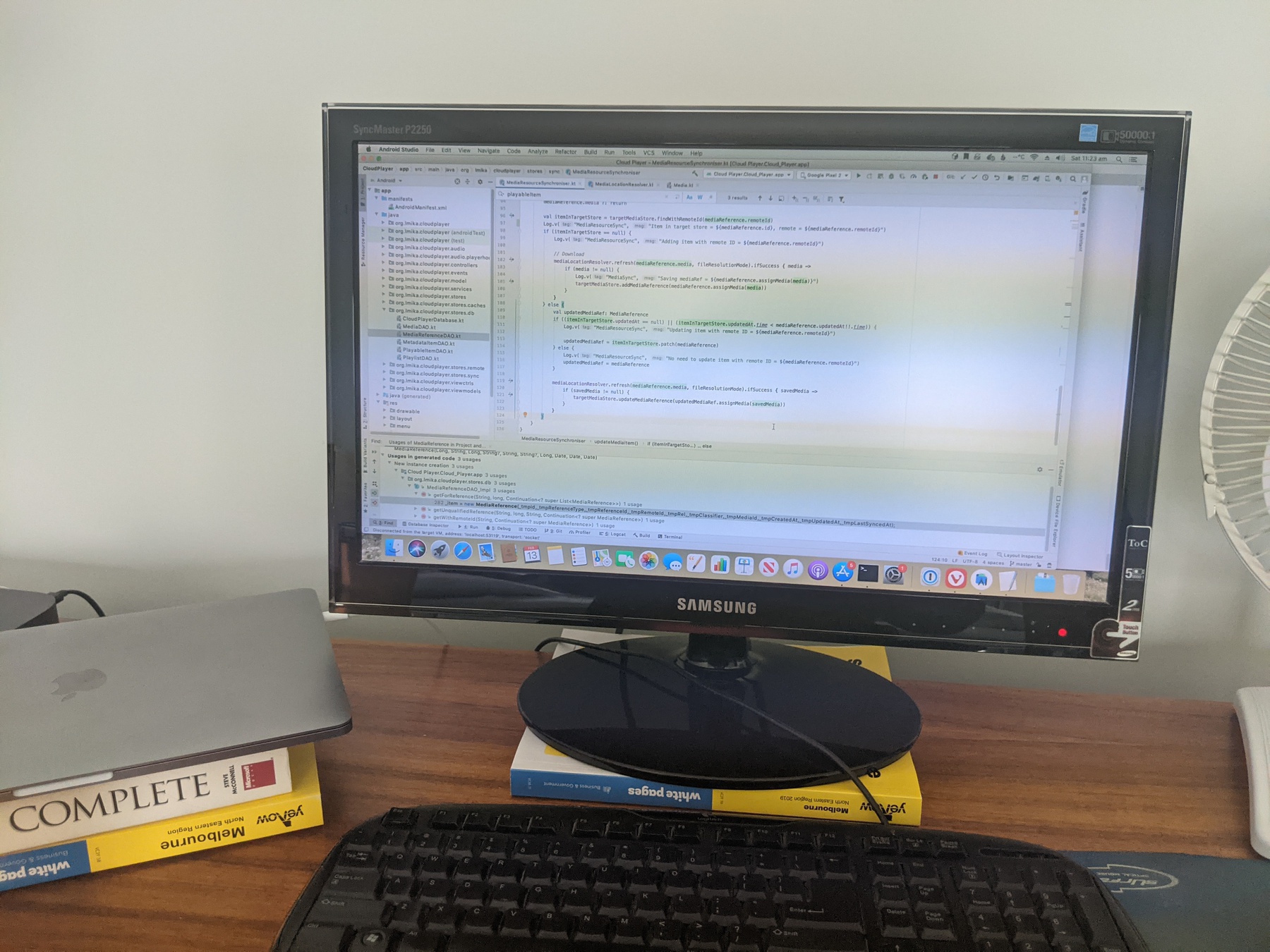
Mind turning slowly into sporg as I try to chase down this bug.