
-
Hard to get out of old habits. I’ve started reading Indie Microblogging by Manton today. So far a terrific read — which natually means that I stopped so that I can save it for “later”. Really need to just finish reading what I find interesting now.
-
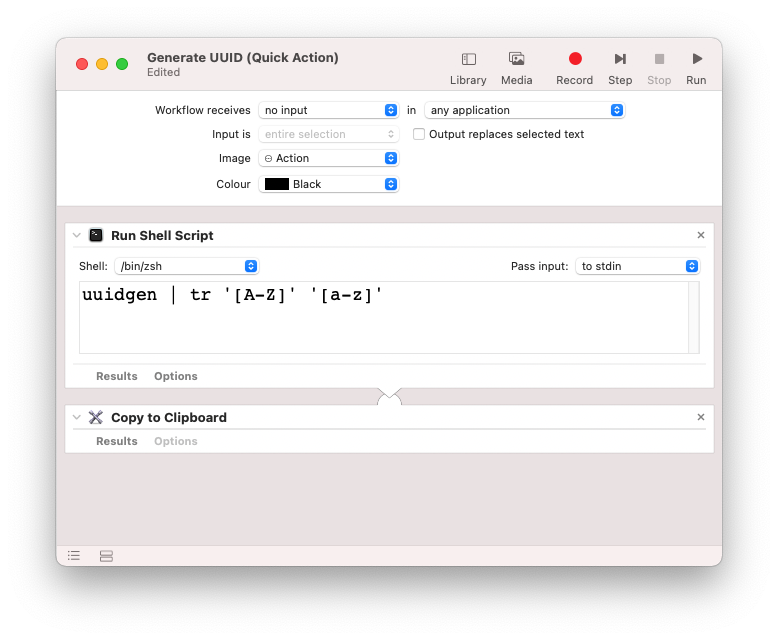
This is by far the most useful quick action I’ve made in Automator. It generates a UUID, and places it in the pasteboard. I’ve got it bound to Ctrl+Opt+Cmd+U and I’ve been using it constantly over the last week (writing a lot of tests with test data).
 screenshots
 -
I think it’s time to close the “Untitled Summer Project”, the service I was working on to upload files to S3 for publishing on Drummer.
The goal — despite not being entirely public — was to have a service that could be used by others to upload images to S3 for the purpose of publishing them to their blog, particularly blogs published using Drummer and served through Old School. I was hoping to have something that I could share with others by the end of Summer.
Well, now it’s Autumn, and I’ve made very little progress on it since early February. So it’s time to cut my losses and shut it down.
I think there were a number of factors that resulted in the failure of this project:
- I wasn’t using it enough to get excited about it. I mean, I was using to manage my uploaded pictures for workingset.net, but I was only doing so occasionally.
- Apart from not using it, I wasn’t getting much out of the project itself. There wasn’t anything exciting about the project from a purely coding standpoint (apart from doing image resizing in the browser using WASM, which might come in handy for some other projects), and if I was getting nothing from using the project myself, there was no other intrinsic motivation to continue working on it.
- I was planning to move on from Drummer and Old School as a blogging platform. I figured giving write.as a try, which also has image hosting, so there was no real need for it anymore.
I think what I need to do for any project that I hope to share with others, I need to share it with others much earlier than when I was originally planning to. I think that feedback from others using it is important for driving the project forward, particularly if I am not getting that drive from using it myself.
other-artefacts -
Here’s another clip of the echidna, taken from the same 2 minute video I took yesterday. It’s also the third video of wildlife looking for food that I’ve posted on this blog. Is a trend forming I wonder? 🤔
videos -
Went for my afternoon walk yesterday, and saw an echidna looking for food. That doesn’t happen every day, so it seemed like a good subject for a video.
videos -
Wondering if I could part with A$ 10,000.00 on a souped up Mac Studio. Very tempting, but that’s a fair bit of money.
-
I’m looking for a new CMS for my side-project journal, which is currently on Drummer and Old School. I’m looking at write.as as a possible contender, and so far it looks promising.
-
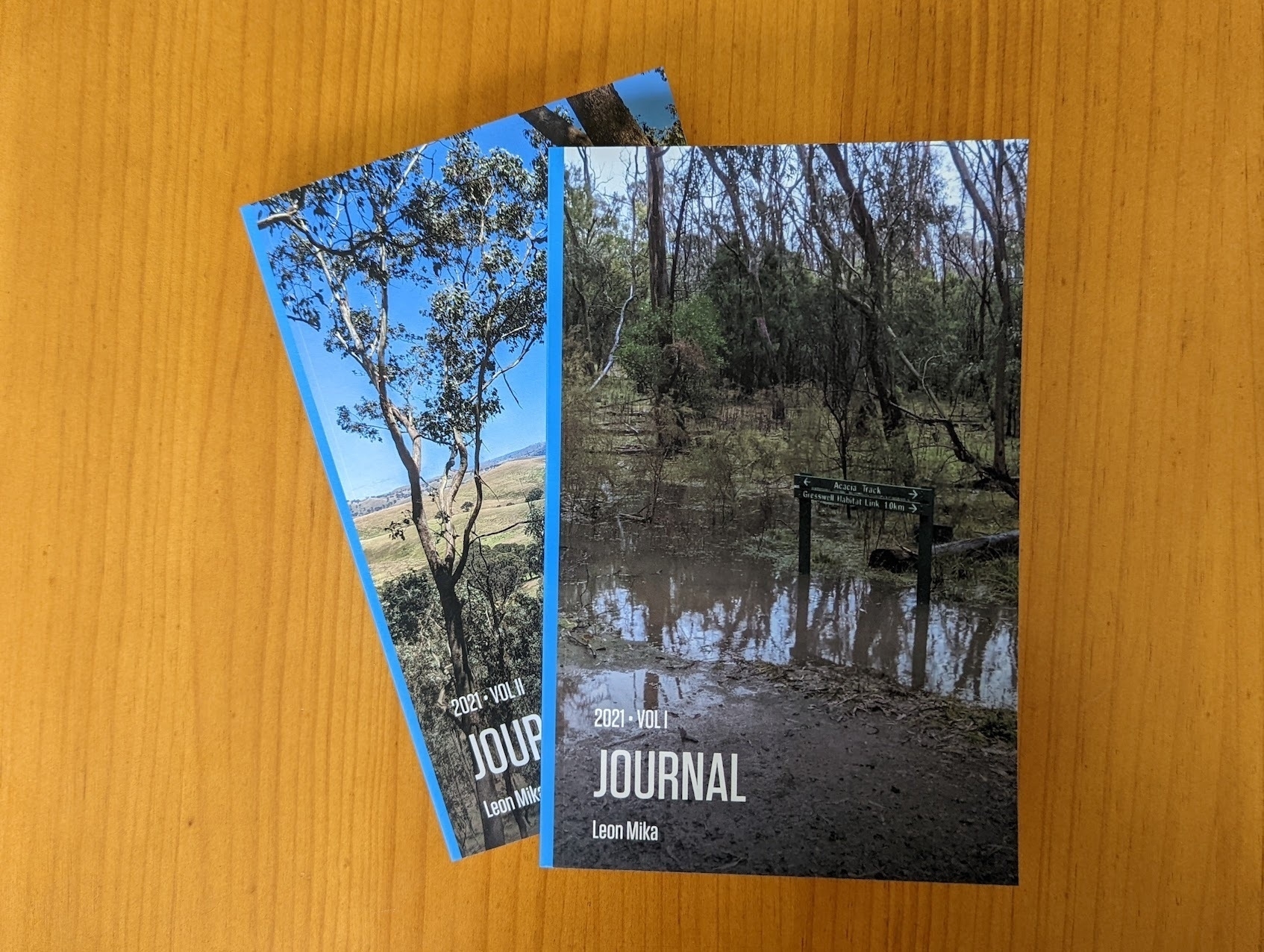
My printed Day One journals for 2021 have arrived, much quicker than I expected. They came out nicely. I think paper covers are the way to go — they feel much better to flip through than the hard cover one I have for 2020.
 photos
 -
I was reminded about the post on streaming apps by John Siracusa when I was browsing Apple Maps today. Do you know that after a search, it takes three taps to dismiss the sidebar, reveling the actual thing I want to see — the map? Do these taps count as “engagement”? 😒
-
Some More Updates of Broadtail
I’ve made some more changes to Broadtail over the last couple of weeks.
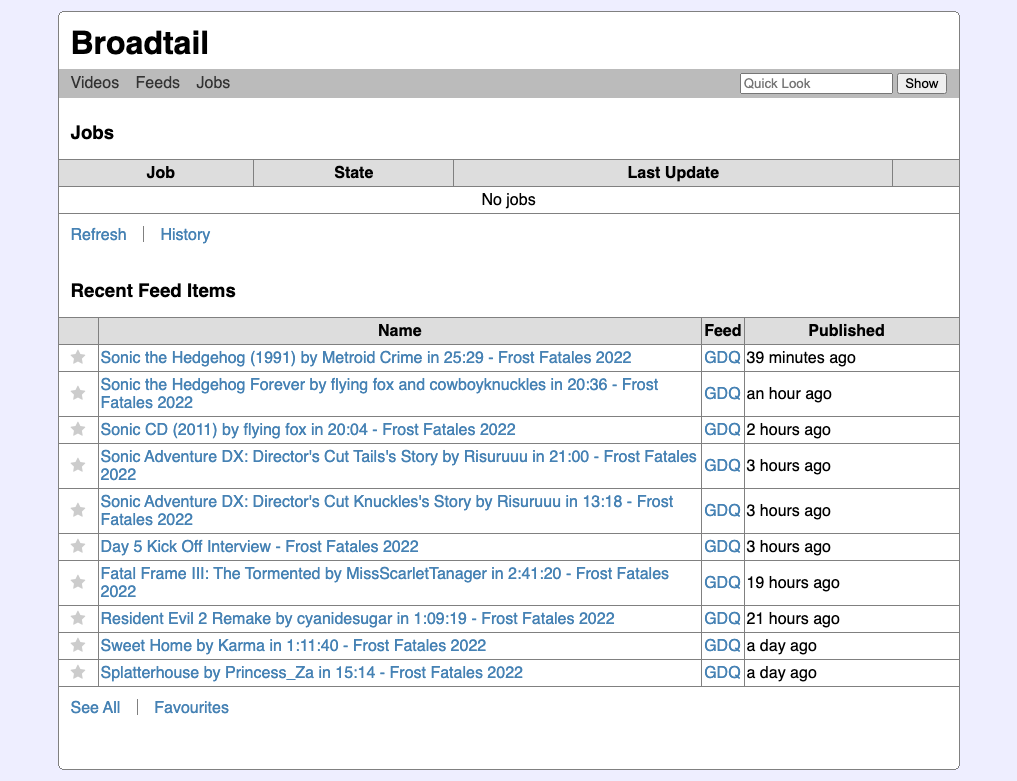
The home page now shows a list of recently published videos below the currently running jobs.
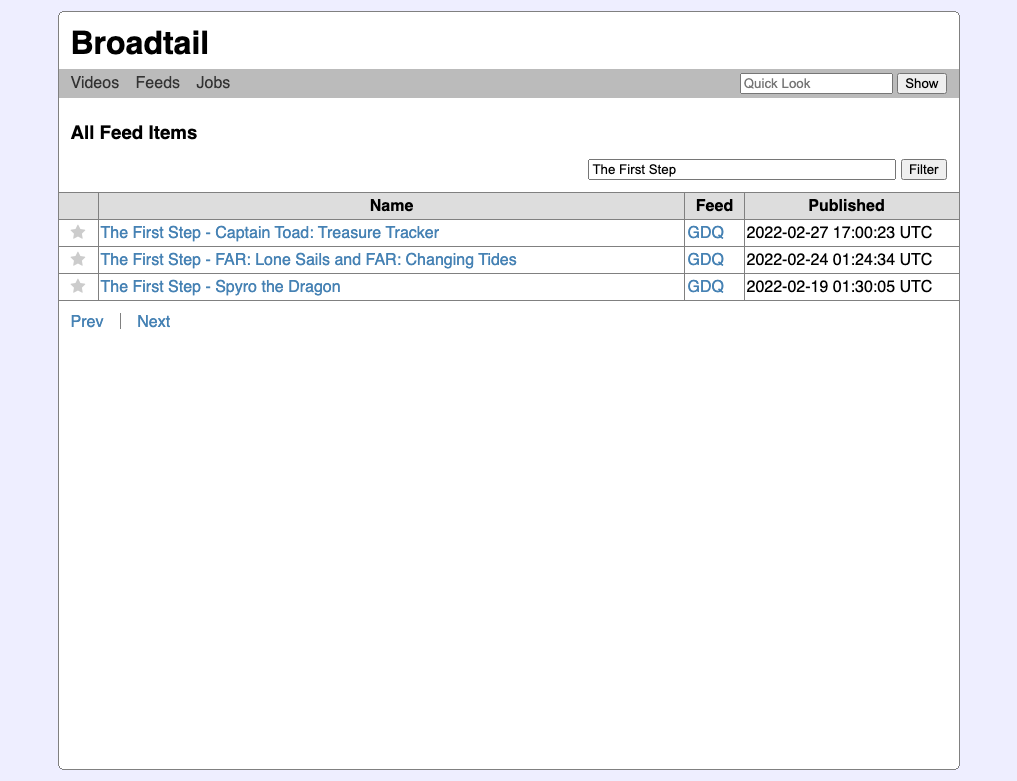
Clicking through to “Show All” displays all the published videos. A simple filter can be applied to filter them down to videos with titles containing the keywords (note: nothing fancy with the filter, just tokenisation and an OR query).
Finally, items can now be favourited. This can be used to select videos that you may want to download in the future. I personally use this to keep the list of “new videos” in the Plex server these videos go to to a minimum.
Continue reading → -
We had a bit of rain last night so the Currawongs were out in force today. It’s always a pleasure listening to their calls, especially when they’re singing in chorus.
-
Super busy week this week. A couple of long days, with a bunch of long design and planning meetings that my voice is now hoarse.
But only a couple of hours left, then I can wind down with a walk, and a listen to the latest Incomparable Game Show. I earnt it this week!
-
Slack’s not great for resolving arguments.
I’m in one now at work. Nothing heated, just a disagreement about a certain design choice. But the ability to post short, sharp responses — not to mention the inherent satisfaction that would come from doing so — adds the possibility of making the whole situation descend to the point where it becomes just like a Twitter-storm. It takes effort to avoid that from happening. It took me effort to do so today.
Maybe something like an “argument” mode would help. When enabled, you can no longer make short posts and are force to write longer ones, maybe with a minimum character count of say 1000 or so. The post will also be delayed by about 15 minutes so that when you do slam a reply out, you have the opportunity to cool off, and reword it.
-
Two things in life there’s never enough of: time, and available USB ports.
-
Speaking of nice development experiences, I took a look at the Playdate SDK yesterday. Docs and tools are really well polished. Managed to get a “Hello World” style “game” built and running in the simulator in about 30 minutes. My pixel artwork skills need work though. 🤦
-
Time and Money
Spending a lot of time in Stripe recently. It’s a fantastic payment gateway and a pleasure to use, compared to something like PayPal which really does show its age.
But it’s so stressful and confusing dealing with money and subscriptions. The biggest uncertainty is dealing with anything that takes time. The problem I’m facing now is if the customer chooses to buy something like a database, which is billed a flat fee every month, and then they choose to buy another database during the billing period, can I track that with a single subscription and simply adjust the quantity amount? My current research suggests that I can, and that Stripe will handle the prorating of partial payments and credits. They even have a nice API to preview the next invoice which can be used to show the customer how much they will be paying for.
Continue reading → -
Nothing so focuses the mind like a deadline, and the mandate to keep it. The easy deadlines are the ones imposed by others. Much harder, and one that I personally need a lot of work on, are the ones that you set yourself.
-
🔗 Simulating Amazon DynamoDB unique constraints using transactions
A technique to simulate a uniqueness constraint on a field not used in the key. Came in handy for solving a problem I was having with DynamoDB today. I wrote more about it here if you’re curious.
links -
Have finally got around to arranging the printed books of my 2021 Day One journal entries. Lot of entries last year, enough for two books actually. Although to be fair, I’m also including blog posts and a lot of photos, which would have definitly increased the page count.
I’m trying my best to maintain some consistency across the printed books. I’ve realised that you can make a choice the first time around, but it’s actually the second time around that your choices become a convention. So I tried being a bit thoughtful about some of the decisions I’m making this year.
That said, I am making some slight deviations from the 2020 book. I’m trying a paper cover this time as I found the hard cover a little bit fragile. I’m afraid to bend the spine too far while reading it as I fear it might tear it from the cover. It’s actually preventing me from flicking through the printed book, defeating the purpose of this exercise. I’ll see if the paper cover is better and if so, I may reprint the 2020 journal again.
One last thing: I do appreciate Day One offering this service, but I wonder if it would have been better if this was offered on their website. There’s too much that needs to happen in the iOS app, and due to the nature of the OS itself, I’m always afraid switching away to another app while a long running process is going on, lest the OS kills it and I’ll have to start it all over again. So I’m left with watching long running progress bars.
-
Looking at wiki software this morning to set up a personal wiki. Lots of great projects out there, it was difficult to choose. Deceided to try BookStack since I like how it arranges pages into bookshelf, books, and chapters. I think some imposed structure would be good for me.
-
Little bit difficult to think about much else given the current news from Ukraine. Certainly doesn’t feel right posting about the trivial things happening here. It’s devastating that it’s come to this and I feel for those suffering from this horrific attack.
-
A good indication that I’m not thrilled about doing something is when I start thinking of ways to automate it. Sure I could spend 5 minutes doing the task manually — look at a Jira board, count the story-points of each ticket, and write the sum in a spreadsheet — but that would be boring! What would be much more interesting is spending a couple of hours writing a script to do this, complete with calls to the Jira API, a Sqlite3 database, maybe some graph drawing routines…
Ok, settle down. Just do it manually for now. Plenty of time to automate it later.
Then again, it would be nice if that story-point sum was calculated automatically… 🤔
-

I’m trying a little experiment on myself where I carry a little notebook with me wherever I go. My goal is to see whether I’d get any value of keeping a daily log of sorts, where anything that might be worth remembering will get written down.
I first tried this a couple of weeks ago, but that attempt was largely abandoned after a couple of days. I thought I’d give it a more serious go this time. So for two weeks, with some exceptions, I will make sure to have a notebook either on me, or within easy reach of me. I started this experiment on Monday, making this day three.
There are a couple of reasons why I’m doing this. The book Steal Like an Artist, and this post (via @amit) were inspirations, and there have been times that, in retrospect, a notebook would have been handy. But in general, I’m just curious to see whether I would get anything out of it. I think a good indication that it’s going well is if I write down a least one item per day. If I actually use to the notebook to recall something, that would indicate success.
-
Let nobody say that innovation is no longer possible in MacOS. One idea I have: making it possible to move windows, off-screen and out of reach thanks to a monitor setup change, back to the center of the desktop. Honestly, I don’t know why this is still an issue in 2022. 😒
-
I went to the newsagents today to buy a ruler. It’s been a little while since I’ve been in one, and I always enjoy going, especially to look at the stationary. Seeing all those pens and notebooks: so many possibilities.