
-
🔗 Apple Watch Series 9 and Ultra 2 Ban Takes Effect; Apple Appeals
The ITC’s ruling was subject to a potential veto by U.S. President Biden by December 25th, but today, the Office of the U.S. Trade Representative issued a statement that it has decided against vetoing the ITC ruling, meaning that the ruling is now final.
It seems odd to me that Apple was expecting a reprieve from the White House over this patient dispute with Masimo. Issuing a veto looks like choosing one US company over another. Doesn’t seem like good political optics to me. Maybe it seemed to Apple it was worth a shot. 🤷♂️
links -
🔗 Hardcore Software: //build It and They Will Come (Hopefully) (paywall)
I remember this Build conference. I was using Windows 7 at the time and it was exciting to see Windows 8 previewed like this. It was a major departure from what I was used to, and I was eager awaiting the Ars Technica reviews of the OS, the apps, and how things like contracts will work for developers.
But… it was an excitement I had for others. I was less than excited about the idea of seeing the desktop take a backseat to this brand new world of Metro and touch based interactions. I guess I was not the only one.
It’s quite a shame really. The devs at Microsoft clearly put a lot of work into re-enginerring the entire OS.
links -
It’s thoughtful posts like this that keeps me on Micro.blog.
Also, chalk me up as one who’d rather keep link previews out of the timeline. I posted a link in Discord and the preview was so obnoxious I wish I could hide it (really Discord? Why can’t I hide it?).
links -
🔗 PlayStation is erasing 1,318 seasons of Discovery shows from customer libraries
The realization has forced people to more deeply scrutinize their digital media purchases and subscriptions and how they value digital content. It’s also leading to calls for investment in hard copies of media.
I still believe that it’s possible to have a (semi-)perminenant representation of media in the digital realm. You just need to make sure it’s in an open, non-DRMed, file that exists on your file system. I know, easier said than done. But it might be time for me to be better here than I have been.
links -
🔗 Hardcore Software 065. SharePoint: Office Builds Our Own Server (link pay-walled)
Yes, believe it or not, I’m reading about how SharePoint was built. I never had a lot of experience with SharePoint myself: although I did work at places which used it, I tried to stay away from Office documents as much as I could, sticking to things like wikis. And yes, I can understand why others may find it pretty crummy (the post gives a few examples of how crummy). But I did find some ideas SharePoint had quite interesting, such as the “everything is a list” concept. I do appreciate this consistent through-line in the product design, much like Unix’s “everything is a file” philosophy. I also like the fact that this extends to user-defined lists, like a very simple database.
Anyway, this paragraph caught my eye:
The idea of Office extended by a website for each Office user and team was incredibly important simply because it made using Office better. It was also a vision we had from the time we acquired FrontPage—everyone should have their own place on the web where it is easy to keep their work and share it with others. We were clearly too early. As we will see it was not just that the world was not ready, the world was anti-ready. SPS fit with the products of the era that remained top-down, complex, and under the full control of IT.
I yearn for the day when organisations make it easy for any employee to whip up an internal webpage for their team. Documents and wikis are nice, but they’re just so limiting in how they show information. The freedom to use real web technologies to present something as best you think you can, while also keeping the data “in house” (password protected, stored on servers the company controls, etc) is just an area on office tech that’s missing.
Case in point: I would love to be able to build a website showing the the status of backlog items that I can share with my team. I don’t want to manage the raw data myself: that’s all being tracked in Jira anyway. But Jira sucks, and it’s really difficult to show an overview of work, especially when they span multiple epics. Having something like a simple dashboard which will pull Jira ticket status and display them as maybe progress bars would be great.
But where am I to host this? Probably not best to do so on the open web.
See also the idea of small databases.
links -
🔗 DOS_deck
Experience classic games with modern convenience at DOS_deck. With full controller support and a carefully curated game collection, enjoy timeless classics and hidden gems, readily available for instant play in your web browser on devices you already own.
Filing this away to try later. Also interesting to see they’re using JS-Dos for this, the same thing being used by F5 To Run, which is cool.
Via Ars Technica.
links -
Seeing everyone blog (yes, actually blog) about their default apps over the last two weeks has been absolutely wonderful. Robb has been doing a fantastic job maintaining an index of these posts, and has now added a network graph showing the links between them. Works great.
links -
100% this!
It was only a year or so ago that I found out that RSS discovery was a thing (coincidentally-but-probably-not-really it was also a year or so ago when I first read Manton’s book which mentions this).
Before that, if there was a site I wanted to subscribe to, and there was no RSS link on the page itself, I wouldn’t bother. Apart from thinking that I needed the link to the RSS feed to subscribe, I also got burned so often by sites that didn’t even have RSS that I just defaulted to assuming there was no way to read their site in my feed reader.
Browsers are getting better at surfacing this though. Vivaldi now shows an RSS indicator in the address bar when it detects that the site has one. But it’s small, and I’m usually not looking at the address bar after entering the URL, so it’s easy to miss. Really, nothing beats putting a link on the site itself.
Now, if you escuse me for a second, I just need to check that I’ve got a link to an RSS feed on my site…
Ok, just checked my own site and while it did have an RSS feed in the “Follow” section, it could be made more prominent across the whole site. So I’ve added a link to the footer as well.
links -
🔗 Google is moving Shopping List and other notes into one app to worry about, Keep
This is somewhat good news, as Keep is a decent note-keeping app. But it’s also concerning because there’s now one major place to keep your data that Google might one day abandon.
It’s striking seeing this line in the first paragraph. I use Keep for my shopping list. It works well, and it’ll be a shame if Google were to shut it down. But there’s also a risk of them being too focused on the app, where they cram some useless AI feature into it. Notion does this, and I wish there was a way to turn it off.
links -
🔗 Canada’s 84-year radio time check has stopped because of accuracy concerns
Interesting article about how Canada broadcasted timing information via radio. Reminds me of the 6 pips played just before the news on ABC radio when I was a kid. I’m guessing they served a similar role.
links -
One way to think about age – we become old when we think and talk more about the past than the future.
Oooh. I feel a little seen. 🫣
links -
🔗 Using Web Components on My Icon Galleries Websites
Lot of neat stuff referenced in this post, like htmx and web components. I’d like to try them in some capacity, like some small web project. Unfortunately, the only things I can think of building right now are things for my job.
links -
Greg Morris wrote an excellent post about personal blogging that resonated with me. I know this is something that I struggle with. There are many posts on my blog that are formal and impersonal. And I hate re-reading them: they’re super boring. On the flip side, seeing posts about my day (sans post about work), of photos and videos I’ve taken, are a joy to relive. I know these are posts I tend to prefer reading on personal blogs of others. I’ll try to write more of those.
Related: Nobody cares about your blog, via. Skoobs.
links -
🔗 XML is the future - Bite code!
I wanted to write something about fads in the software development industry when the post about Amazon Prime Video moving away from micro-services back to monoliths was making the rounds. A lot of the motivation towards micro-services can be traced back to Amazon’s preaching about them being the best way to architect scalable software. Having a team from Amazon saying “micro-services didn’t work; we went back to a monolith and it was more scalable and cheaper to run” is, frankly, a bit like the Pope renouncing his Catholic faith.
I didn’t say anything at the time as doing so seemed like jumping on the fad wagon along with everyone else, but I have to agree with this article that this following along with the crowd is quite pervasive in the circuits I travel in. I did witness the tail end of the XML fad when I first started working. My first job had all the good stuff: XML for data and configuration, XSLT to render HTML and to ingest HL71, XForms for customisable forms. We may have used XSD somewhere as well. Good thing we stopped short of SOAP.
The whole feeling that XML was the answer to any problem was quite pervasive, and with only a few evangelists, it was enough to drive the team in a particular direction. And I wish I could say that I was above it all, but that would be a lie. I drank the cool-aid like many others about the virtues of XML.
But here lies the seductive thing about these technology fads: they’re not without their merits. There were cases where XML was the answer, just like there are cases where micro-services are. The trap is assuming that just because it worked before, it would work again, 100% of the time in fact, even if the problem is different. After all, Amazon or whatever is using it, and they’re successful. And you do want to see this project succeed, right? Especially when we’re pouring all this money into it and your job is on the line, hmm?
Thus, teams are using micro-services, Kubernetes, 50 different middleware and sidecar containers, and pages and pages of configuration to build a service where the total amount of data can be loaded into an SQLite3 database2. And so it goes.
So we’ll see what would come of it all. I hope there is a move away from micro-services back to simpler forms of software designs; one where the architecture can fit entirely in one’s head. Of course, just as this article says, they’ll probably be an overcorrection, and a whole set of new problems arise when micro-services are ditched in favour of monoliths. I only hope that, should teams decide to do this, they do so with both eyes open and avoid the pitfalls these fads can lay for them.
long-form-posts links -
A lawsuit, the last refuge of a scoundrel.
(With apologies to the Simpsons).
P.S. Like the new design of Birchtree.
links -
🔗 Reddit mods fear spam overload as BotDefense leaves “antagonistic” Reddit
I wonder if anyone at Reddit’s C suite has ever been a moderator. That this API fisaco is affecting the tools that mods use to keep the community spam free and happy should give them pause. That they don’t care is an indication as to how detatched they are from those “on the ground”.
links -
🔗 Poor man’s team bonding: recurring Slack threads
Could be a nice idea for blogs as well. Maybe for someone who’s trying to post at least once a day, but occasionally can’t think of something to write about. Not that I know anyone like that.
links -
Interesting piece from the Verge about the rise and fall of Google Reader, which was killed 10 years ago. I wasn’t a big Google Reader user, and I still believe that the death of Google Reader was ultimately good for the RSS format. But I know how much people loved using it and how devastated they where when Google decided to pull the plug.
One thing that caught my eye was the executive’s comment about working on Google Reader being a waste of the engineers’ careers. Taking the comment at face value1, it doesn’t seem like a waste at all. Sure there were “only” 30 million users of Google Reader, but it’s obvious that they were passionate users of the service. And it would’ve been an honour working on something that elicit such a strong emotional response from your users, let alone being the one that started it all with the original prototype. I can’t imaging getting that same buzz by one of the thousands working on Google Search or Google+.
-
I’m guessing the comment was slightly coloured by the fact that the person making it wasn’t too keen on Google Reader. ↩︎
links -
-
🔗 Double-screen ‘free’ TV will show you ads, even when not in use - Ars Technica
What would you be willing to do for a free TV? If the answer is hand over information about what you watch,[…] how much money your household makes, what food and brands you like, and your race and be subject to on-screen ads at any time, then Telly’s got the deal for you.
I understand that not everyone can afford a good TV, but the price here — tracking and a constant stream of ads — feels a bit too high. It occured to me that monitors can’t do this. If a company discovers that their monitor is tracking what the user is seeing, the manufacturer will get sued out of existance. Maybe having a monitor is the solution to a TV with zero tracking (they do need to be larger though). 🤔
It’ll also be funny to see how quickly people get into this and disable all the ad/tracking stuff. I’m betting it’ll be done within three months.
links -
New post by Steve Yegge. I always enjoy his writing but please, can someone buy Steve a domain name? He changes blogging platforms so often it’s difficult to follow him (well I guess Twitter would have worked at one point).
Via: birchtree.me
links -
I’ve wanted attr() to be more widely accepted in CSS values since, well, I can’t remember. A long time. I want to be able to do something like:
p[data-size] {width: attr(data-width, rem);}I realize adding this would probably lead to someone creating a framework […] where all the styling is jammed into a million data-*attributes […], but we shouldn’t let that stop us.
Is it too late to vote for this? I’d love to be able to do this for background images. Relying on JavaScript to get the URL from the attribute and style the element is such a hack.
Via: Jim Nielsen
links -
There is no way to turn this news feed off. The best you can do is “manage interests” which kicks you out to msn.com to have you tell it what topics you prefer.
Definitely not trying Windows 11. I hate software that pushes news onto you, unsolicited and with no easy way to turn off! I’ve have my news sources that I read and trust. I don’t want things pushed to me from sources with some commercial agreement that doesn’t have my interests in mind.
links -
Really enjoying these series of articles from The Verge about UI and UX design. Lots of facinating subjects there.
Oh, I also flunked the logo colour test, getting 1 out of 8. I guess a career of chromatology is out of the question for me. 😄
links -
🔗 Children’s author Paul Jennings reflects on childhood, success and his writing process
I’ve was a huge fan of Paul Jennings work when I was a kid. Everything he wrote that I read (or watched), I enjoyed. It’s been a while, but I’m sure I’d still like it if I read it today.
links -
🔗 Google is killing most of Fitbit’s social features today
An amusing thought came to me while I read this: Google has an opportunity to play to it’s strength and act like the assassin for features or services. Don’t want to support something? Get Google to acquire you and inevitably shut you down. It’s such a unique niche that companies should be paying Google for this service.
I’m not a Fitbit user, but I know how it feels to be burned by Google’s obsessive need to shut down things I find useful, so I can understand all the upset over this.
links -
🔗 The Command Line Is the GUI’s Future
It has always been a truism that what we have gained in ease of use by switching from the command line to the graphical user interface, we have lost in efficiency.
[…]
What Microsoft just showed completely changes this calculation. Their LLM-based user interface is both incredibly powerful and incredibly easy to use. In fact, it’s so easy to use that there almost seems no point in even having a traditional GUI.
Swings and roundabouts. 😏
Honestly, it’s kind of exciting to see the two UI styles married this way. Point and click is fine, but sometimes, when I know what I want, I just want a way to “tell” the computer what to do, rather than go through the motions “guiding” it to my desired state. This is why I prefer the command line over a GUI for certain tasks. And yeah, Office has scripting but unless you’re in there constantly, you find yourself relearning it every time. Having a prompt like this might be where the sweet-spot lies.
links -
🔗 After 6 long months, an Android phone finally cloned the iPhone 14
The screen-shots of this “mini capsule” are hillarous. The animated waves that appear when the capsule is expanded; the fact that the only thing it can display is the battery level since there’s nothing like Live Actions. The capper is the “90%” on the right side of the capsule, right next to the 90 in the battery indicator. You know, just in case you need reminding that the battery is at 90%. Champions indeed!
Hilarity aside, it’s a little sad seeing these Android OEMs doing everything they can to rip off Apple’s design. And it’s not just those in the long tail of OEMs either. Seeing Samsung half-arse features months after they debut on the iPhone, just to abandon them months later is really cringeworthy (anyone remember “AR Emoji”, their rip-off of Animoji). It’s past time they developed some taste on their own.
links -
Hmm, it’s hard not feeling a little unsettled after reading this Stratechery post. One thing’s for sure, I’m a bit more doubtful of the post I wrote two days ago.
links -
I tried ChatGPT for the first time this morning. I needed a shell script which will downscale a bunch of JPEG images in a directory. I’m perfectly capable of writing one myself, but that would mean poking through the ImageMagick docs trying to remember which of the several zillion arguments is used to reduce the image size. Having one written for me by ChatGPT saved about 15 minutes of this (it wasn’t exactly what I wanted, I did need to tweak it a little).
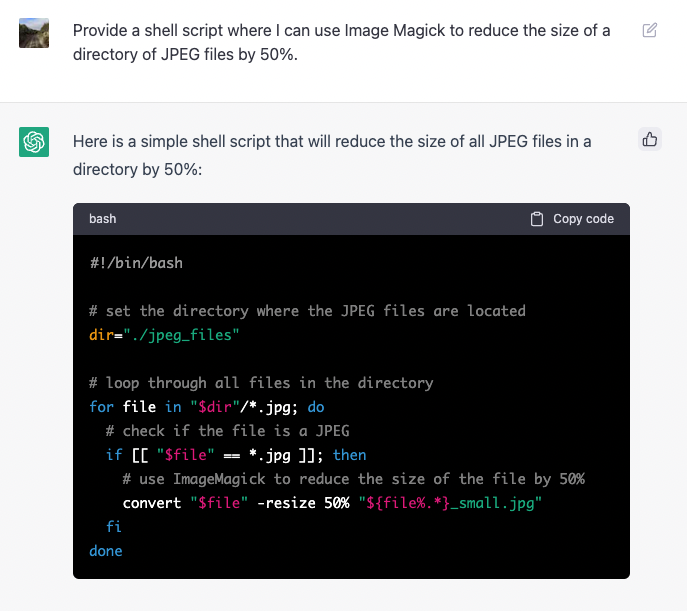
I don’t know what the future holds with AIs like this, and I acknowledge that it has had an effect on some peoples’ living (heck, it may have an effect on mine). But I really can’t deny the utility it provided this morning.
links -
🔗 The Magic of Small Databases
I kinda want this but for internal databases. There’ve been several times at work where I’ve had to collect semi-structured information in a spreadsheet or a wiki page comprised solely of tables. There’s always some loosely defined convention around how to represent it (use this colour to indicate this particular state) or when it should be changed (change this label to “In Review” until these people have seen it and then change it to “Confirmed”).
One example is how we manage releases: which services we’re pushing out and what commits they are, which environments it’s been deployed to or tested in, whether the other teams or the person on-call are aware of it and have signed off, etc. This is all managed in wiki pages that follow a standard layout, and it’s… okay. It was a convention that has grown out over time as we were working out our release procedure. And it made sense keeping it relatively informal as we were trying to work out our groove. But that groove has been formed now, and it would be nice to formalise the process. But doing so means that there’s a lot of manual labour keeping these release documents correct and up to date. And since it’s all in a centrally managed wiki, it’s difficult to automate away things that are managed by other systems like our code repositories.
A tool that can be hosted on-prem which will allow anyone to spin up a new document-base database (either for the team or themselves), define a very loose schema and some views, and put a very simple workflows and code macros would be great. The trick is trying to walk the line that separates something that basically is like a hosted version of Excel verses something that will require so much setup work that no-one will bother with it. I’d imagine that’s a tricky balancing act to follow.
links -
What gets me about Twitter killing access to third-party clients is the lack of comms to the developers. No shutdown timeline. No chance to let the devs communicate this to their users. Nothing but cowardly silence. How utterly disrespectful!
links -
🔗 Jean-Michel Jarre’s “Oxygene Pt. 4” in 19kb of JS code
A pretty good recreation of Oxygene Pt. 4. Also, I’ll have to explore this tool a little more.
Via waxy.org.
links -
🔗 Twitter suffers major outage in Australia and New Zealand
I was about to make a joke about Twitter not paying their PagerDuty bill. But then it occurred to me: you probably don’t even need PagerDuty if you can just hear about outages from the news.
links -
A Mac with everything you’d want in 1995.
A fully loaded version of System 9 running in your browser. Posted here because I found myself opening and playing around with this over the last few days.
(via. podiboq in the Hemispheric Views Discord)
links -
🔗 github.com/charmbracelet/vhs
This little tool is awesome. It allows you to easily make GIFs of a command line session from a text-based DSL. I tried it on the full screen TUI app I’m working on and it worked flawlessly.
Now wondering if I could use it for automated testing. 🤔
-
Endless driving game in the browser. Pretty frickin’ well done. There’s also a Medium post on how it was put together.
(via. Ars Technica)
links -
🔗 Pocket Casts Mobile Apps Are Now Open Source
Wow, I did not expect that. Although I probably should have since it’s owned by Automattic now.
links -
🔗 Who is ready for a fleet of cubesats flying over cities, displaying ads?
The well of bad ideas may not be bottomless, but it certainly is deep.
links -
🔗 Google suffers from a digital petro curse
Hearing the story about Stadia reminded me of this post by DHH. His thoughts on why Google can’t keep a new product around for more than a few years is insightful.
links -
Google’s damaged reputation made the death of Stadia a self-fulfilling prophecy. No one buys Stadia games because they assume the service will be shut down, and Stadia is forced to shut down because no one buys games from it.
What’s there more to say? 🤷
links