
-
April usually means controlled burns, and they’re conducting these burns at a bush reserve near my place. I was afraid that the smoke would be an issue, but so far it’s been such a non-issue I was wondering if the burns were actually called off. Apparently not.


-
About Those Checkmarks
This posts going to be about Twitter. Yes, I know; another one out there. It’s also going to be a bit speculative in nature, so feel free to skip it if you like. I’ve been reading the coverage over the “retirement” of the legacy verification system, both in the news and on the socials. And what I find interesting about this whole affair is all the new Twitter Blue subscribers complaining about people that had the checkmark choosing not to sign up. Continue reading →
-
Note to self: a shell script will always be quicker and easier to write than a Go program for a throwaway thing, no matter how much you wished it to be otherwise.
-
Day One and Project Jurassic
So, Day One is in danger of being sherlocked by rumor’s of Apple’s upcoming journaling app: Mayne echoes the sentiment of several app developers who have been frustrated when Apple launched in-house competitors to the apps they have introduced to the ecosystem, often copying features those apps innovated and adding functionality that only Apple can offer, per the iPhone’s privacy and security policies and APIs. I’m a user of Day One and I have my doubts that Apple’s app would be a drop-in replacement for my journaling needs. Continue reading →
-
Nerd Counterflex
You know that Washington Post article that has the list of websites Google used to train Bard? I been seeing people post screenshots of their sites in the training set on their blogs and Mastodon. This morning I read a post from Chris Coyier about it: My largest corpus of writing to date is on the web at css-tricks.com (along with many other writers), so naturally, I’m interested in seeing if it was used. Continue reading →
-
Options For Self-Hosting Code Repositories
I’m considering something that some might say is stupid: I’m looking at options for self-hosting my personal code repositories. I’m coming around to the idea of having my own domain for things like Go packages. It’ll provide more opportunities for adding some structure to my repos, rather than having them all hang off a single github.com/lmika namespace. Plus, my personal code management system is reasonably good at the moment so, naturally, the time has come to change all that 😛. Continue reading →
-
It’s always fun playing the “which faraway land is closer to me” geography puzzle when setting up an online services that doesn’t have a presence in Australia.
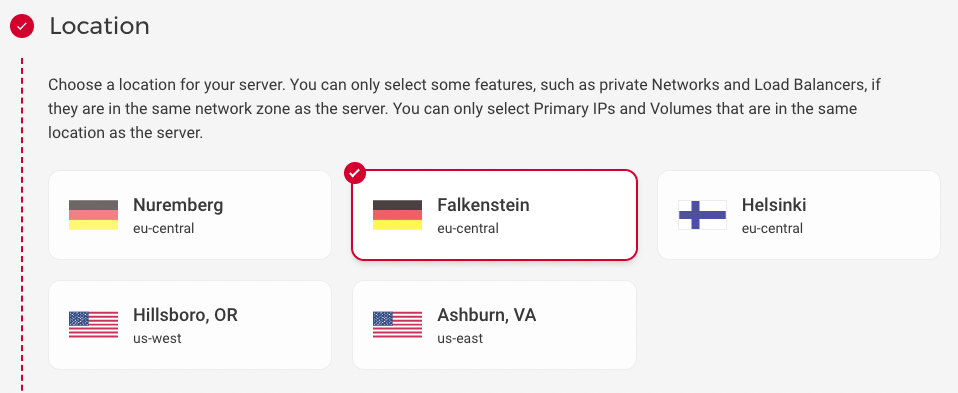
The answer is Hillsboro, OR — 13,021 KM from Melbourne.
-
Dear The Economist,
Please restore the witty headlines you use for your articles to the digital edition. That’s one of the reasons why I read you. I know you include them as postscripts at the bottom, but it’s not the same.
Sincerily,
Me
-
Sunny day today, yet a bit chilly. So the hat and jacket ensemble is out at the moment.
-
Adding a new feature to dynamo-browse and now I’m beginning to wonder if this is why JavaScript has both a
nullandundefinedtype. In short: dealing with null pointers suck. They suck in Go and I’d imagine they’d suck a million times more in C. Better to have a dedicated type representing an undefined value, with all the associated methods to simplify the code.The thing is: JavaScript should’ve not exposed this to the user. Do they really care that
nilandundefinedare two separate things? Was it worth the added confusion. Hmm. I’ll try not to make the same mistake. -
Got to use one of the software tools we build and sell at work for a “real” purpose today, as in not just to test something. Felt good. Don’t get to do that super often.
-
Maybe, before AI swallows our careers to the point where we’re little more than glorified prompt engineers, they’ll be a brief period of time where AI does the boring things in software engineering. Leave us to do the fun stuff like write the code. They can review it for us, like some fancy linter.
-
🎵 Going Home: Theme from Local Hero
This week’s earworm. Apparently I loved this track when I was a little kid. Well, apart from the very 80’s sound (not a criticism), I’d say the younger me had great taste.
-
This teeny tiny lizard made its way into my house somehow. I’ve seen it on and off over the last week, but I managed to catch it and put it outside. There’s another one running around that I’ll also need to find and rescue.


-
There is no way to turn this news feed off. The best you can do is “manage interests” which kicks you out to msn.com to have you tell it what topics you prefer.
Definitely not trying Windows 11. I hate software that pushes news onto you, unsolicited and with no easy way to turn off! I’ve have my news sources that I read and trust. I don’t want things pushed to me from sources with some commercial agreement that doesn’t have my interests in mind.
-
I’d argue that Google Reader shutting down was probably one of the best things that could happen to RSS. It might’ve been bad at the time, but it gave way to services like Feedbin that respect open standards and bring new users to the format, like myself. Having a large company like Google suck up all the oxygen in the room can’t have been good for RSS long term.
-
My Pinboard subscription has expired today. I don’t think I’ll be renewing it. Might be time to look for another way to manage my bookmarks.
-
I think GitLab wasted their effort building their “queued” MR comment feature, in which comments added to code lines are not seen by the submitter until you click “Finish Review” at the bottom of the page. I’ve never concerned myself with the feeling that I need all my comments sent to the submitter at once.
Oh sure, I’ve written a comment and then deleted it minutes later after going a bit further in the code, and I can see the benefit of this feature catching those. But I’ve trained myself to avoid doing that by simply reading ahead. I try not to raise a comment if there’s a chance that I’ll need to go back and modify/delete it. Saving the effort from catching these before the submitter sees them doesn’t seem like it’s worth the complexity of this feature, especially considering that other code review tools I usually used (which is really only GitHub) doesn’t work like that.
No, what I really want GitLab to do is hide/auto-approve files matching a certain pattern. This would be perfect for ignoring generated code changes. I don’t care if generated code changes. I really don’t. And I hate scrolling past these in MRs I need to review, especially when they take up a significant proportion of the changes. It looks like GitLab has an open issue to address this. It’s a shame that it hasn’t been addressed sooner, before this queued MR comment feature was shipped.
Yes, I’m complaining about this because I’m in a mood and I don’t like reviewing code. I blame the fact that it’s a Monday for that.
-
Wow, some serious work’s happening on the overhead wires of the train line. Looks like they’re replacing these old stanchions. I guess they’ve reached their end of life. Not sure how long they’ve been in service but they look quite old. Certainly older than me at the very least.


-
Building F5 To Run
At the risk of talking about something that I’ve only just started, I’d thought today I write about what I’m working on right now. I’ve been going through my digital archives this weekend, trying to get it into something more permenant than the portable USB drives it’s currently stored on. Amongst all that stuff is a bunch of QBasic apps and games I wrote way back when I was a kid. Continue reading →
-
Tending to the archive of all my old projects, documents, music, etc. that have survived the many machine transfers over the years. It wasn’t the original plan for this morning, but I think it’s best I work on this now. Not sure the portable drives they’re currently on will last much longer.
-
Finally got my Twitter archive and uploaded it to Micro.blog (thanks @manton for the awesome feature). Happy that I’ve got an archive of them now, but if I’m honest, there’s only one tweet that I really want to keep.
-
I realise now the problem I have with Twitter’s request archive settings pane. It’s prompting for a password when I open the pane, not when I request the archive. I want to make sure that my request is still ongoing and I haven’t missed the “in-app notification” or it hasn’t fallen on the floor due to some queue that was backed up or no longer running or goodness knows whatever else is going on over there.
So visiting this settings pane and seeing this:
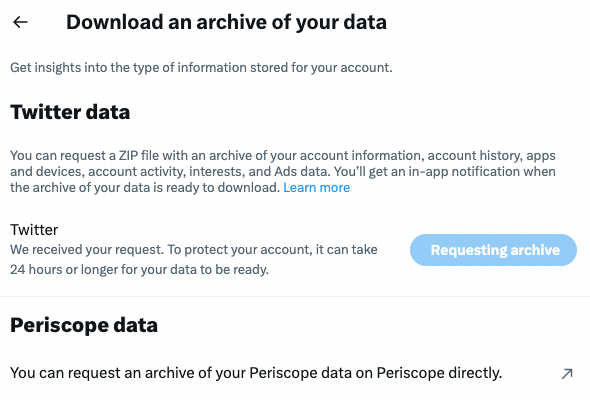
provides a good indicating that the request is still in progress.
But refreshing the page is showing the password prompt that I complained about yesterday. I completely understand getting the password challenge when I request an archive, but when I want to simply open the settings pane? Is knowing that I’ve got a pending archive request considered sensitive enough to require a password check?
Anyway, once I get the archive, I hope never to open settings again (except to eventually close my account). And just as well. I can’t say that it’s a good looking settings page. Everything looks so dull and samey.
P.S. It’s been over 24 hours, what the heck is going on over there? I have so few tweets it would’ve been quicker for me to type them out by hand.
-
Made some improvements to my Keyboard Maestro macro which converts selected text from camel case to upper-snake case. Made a small fix to deal with common abbreviations like
URLorAPI, which usually appear in all uppercase. The previous version was treating each letter as the start of a separate word, so thatURLwould be changed toU_R_L.Here’s the JavaScript portion of the macro:
'use scrict';

const commonAbbrevs = ['URL', 'API', 'SQS', 'DB'];

(function() {
  let app = Application.currentApplication()
  app.includeStandardAdditions = true;

  let text = app.theClipboard();

  // Capital case the common abbreviations so that they'll be properly cased
  for (let abbrev of commonAbbrevs) {
    let capitalCasedVersion = abbrev[0] + abbrev.substring(1).toLowerCase();
    text = text.replaceAll(abbrev, capitalCasedVersion);
  }

  // Convert to upper snake case
  let newText = text.replaceAll(/\B[A-Z]/g, "_$&").toUpperCase();

  app.setTheClipboardTo(newText);
})();
Side-note: when I first heard that the
letkeyword was going to be coming to JavaScript, I heard others say that they wishedletwould effectively make a constant, much like howletworks in Swift. I don’t hold a strong opinion on this, but I kinda wish that ECMA went through with that, since I see a lot of JavaScript code useconstin place ofletwithin a function block.I must say, I’m not a huge fan of this practice. I mean, I can appreciate why they do it, since it reduces the chances of accidentally overriding a variable value. But being someone use to languages where
constis reserved for constants values at the top-level, it doesn’t look aesthetically pleasing to me. I think I’ll keep using mylets. -
If Musk wants to save money on SMS OTPs, then he can increase the authentication timeout on Twitter’s setting page. I’ve been challenged for an OTP on average once per hour as I wait for my archive to be ready.
Another option is to fix OTPs via emails. I tried that a few times but I never got one.