
-
Start of Yet Another Project Because I Can't Help Myself
One of the reasons why I stopped work on Lorikeet was that I was inspired by those on Micro.blog to setup a Plex server for my YouTube watching needs. A few years ago, I actually bought an old Intel Nuc for that reason, but I never got around to setting it up. I managed to do so last Wednesday and so far it’s working pretty well.
The next thing I’d like to do is setup RSS subscriptions for certain YouTube channels and automatically download the videos when they are publish. I plan to use “youtube-dl” for the actual video downloading part, but I’m hoping to build something that would poll the RSS feeds and trigger the download when new videos are published. I’m hoping that this service would have a web-based frontend so I don’t have to login via SSH to monitor progress, etc.
Continue reading → -
Abandoning Project Lorikeet
I’ll admit it: the mini-project that I have been working on may not have been a good idea.
The project, which I gave the codename Lorikeet, was to provide a way to stream YouTube videos to a Chromecast without using the YouTube app. Using the YouTube app is becoming a real pain. Ads aside, they’ve completely replaced the Chromecast experience from a very basic viewing destination to something akin to a Google TV, complete with recommendations of “Breaking News” from news services that I have no interest in seeing.
Continue reading → -
Two People
There are two people, and each one has the same problem that they want to get solved.
The first person chooses the option to pay $10 a month, and all they have to do is sign up to a service that will solve the problem for them. The service they sign up for takes care of the rest.
The second person chooses the option to pay $15 a month, 20 hours of work to get something built, and an ongoing commitment to keep it maintained.
Continue reading → -
(Hyper)critical Acclaim
There were a couple of events that led me to writing this post. I’m sure part of it was seeing the posts on the 10 year anniversary of Steve Jobs, although such an event would probably not have been sufficient in itself. What tipped it over the edge was seeing the Ars Technica review of iOS showing up in my RSS feed on the same day. Pretty soon I’m expecting the MacOS review to drop as well.
Continue reading → -
On Choosing the Hard Way Forward
This is about work, so the usual disclaimers about opinions being my own, etc. apply here.
I have an interesting problem in front of me at the moment: I’ve need to come up with a way to be notified when a user connects to, or disconnects from, a PostgreSQL database. This is not something that’s supported by PostgreSQL out of the box1, so my options are limited to building something that sits outside the database. I can think of two ways that I can do this: have something that sits in front of the database which acts as a proxy, or have something that sits behind the database and generates the notifications by parsing the server log.
Continue reading → -
Some Notes About the Covid-19 Situation
Now that the vaccines are here and are (slowly) being rolled out, and that Covid zero is no longer achievable in any realistic sense, the pandemic seems to be taking on a bit of a different vibe at the moment. I am no longer religiously watching the daily press conferences as I did in the past. They’re still occurring as far as I know, and I do appreciate that the authorities are showing up every day once again to brief the public.
Continue reading → -
On Confluence
I’m sorry. I know the saying about someone complaining about their tools. But this has been brewing for a little while and I need to get it off my chest.
It’s becoming a huge pain using Atlassian Confluence WISIWIG editor to create wiki pages. Trying to use Confluence to write out something that is non-trivial, with tables and diagrams, so that it is clear to everyone in the team (including yourself) is so annoying to do now I find myself wishing for alternatives. It seems like the editor is actively resisting you in your efforts to get something down on paper.
Continue reading → -
On Apple's Media Release Gymnastics
I started listening to the latest Talk Show, where John Gruber and MG Siegler discuss Apple’s media release of the class action settlement. Releasing it to the major media outlets in such a way as to spin the guideline clarification as a concession to developers, even though nothing has actually change, is genius if true. I imagine that’s why Apple’s PR department get the big bucks.
But I wonder if Apple has considered the potential blowback of this approach. I might be naive here, but I can’t help wonder whether these media outlets publishing that Apple hasn’t actually conceded anything will eventually realised that they have been had. Would that affect the relationship between the two in any way? Say Apple wants to publish some good news and expect these outlets to maintain the favourable air of their release. Would they do it?
Continue reading → -
Post Of Little Consequence
I’m wouldn’t call myself a regular poster on this blog. I don’t have a goal of writing a post a day or something. But I do want to keep it up with some frequency, and post at least one item a week. I realised today that it’s been a week since my last post.
However, due to the current lockdown, very little of note has happened over the last week. Apart from work, TV, reading, and doing a few personal projects on the side, there really isn’t much going on. So it was hard to come up with something that was interesting to write about.
Continue reading → -
Six Weeks Off Twitter
It’s been roughly six weeks since I’ve stopped using Twitter on a daily basis. I initially took a break to stay away from some anxiety inducing news, and I was initially going to return to daily use once that passed. But after hearing others on Micro.blog post about their experience closing their Twitter account, I decided to see how long I can go staying off Twitter myself.
I wouldn’t say that I am a big Twitter user. I don’t have a Twitter audience (I think my follower count is in the single digits), I hardly ever tweet or reply, and although I have a few friends and family on there, I have other means of communicating with them that I tend to use more often. The only thing I would miss are the occasional interesting or amusing tweets from those that I follow, something that is not guaranteed in any particular reading session.
Continue reading → -
Seeking Out Bad News
Sometimes I wonder if I’m just going out of the way to seek bad news. Maybe it’s because I think that if I don’t, then a problem will go unaddressed as no-one else is aware of it.
There’s probably some evolutionary trait to this. Being the one that hears a predator, and reacts to it before anyone else, is an advantage. But in this day and age, many of the problems that I have anxiety about is pretty much known by everyone, and addressing it in any meaningful way is beyond my direct control.
Continue reading → -
A Year On Micro.blog
It’s been a year since I’ve signed up to Micro.blog and written my first post, and the only regret I have is that I didn’t do it sooner.
The reason for joining was to write more; to focus less on the blogging engine and more on the blog itself. At the time I have only posted seven times over a period of 9 months. In the last year, that post count has risen to 222. I guess I can call that objective achieved.
Continue reading → -
Working On The Weekend
I’ve saw a Tweets last night saying that the best thing a young person can do to help their career is to work on the weekend. The implication there is that being the one that “puts in the extra hours” can seem, in the eyes of your employer, like you’re the hardest worker there, that you’re committed to the project and the job. This could lead to bonuses, promotions, perks, a reputation, you name it.
Continue reading → -
Stumbling Into the Concept of Narrating Your Work
About a week ago, we had a retro. One of the things that was brought up was the sense that management felt that the team was not delivering as much as we could be. There are a number of reasons for this. For one, the higher ups work in Perth, a good 3,452 KM away from Melbourne. Another was that a lot of the work the team deals with is experimental in nature: more R&D vs. product development (a large portion of it involves dealing with a lot of barely supported, and completely undocumented APIs for MacOS).
Continue reading → -
On the Souring Relationship Between Apple and its Developers
Listening to episode #430 of ATP yesterday, it was kind of shocking to hear the loss of good will experienced by the hosts towards Apple and their developer relations. I can’t say that I blame them though. Although John’s point about lawyers making the case for Apple is a good one, I do get the same feeling that Marco does about Apples opinion about developers, which is not a positive one.
Continue reading → -
Podcast Roll 2021
Yesterday, @Munish had the courage to share his podcast subscriptions1. Sensing an opportunity to talk about with what I’m currently listening to, even though it may reveal more about myself that I’m usually comfortable with, I’m taking up his dare and sharing mine.
So, here is my podcast roll as of early May 2021:
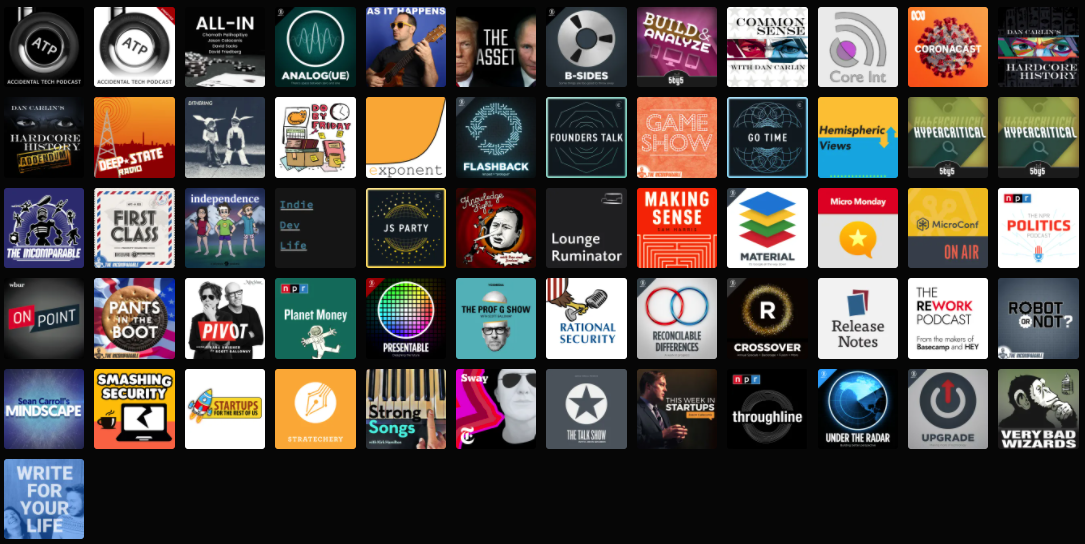
The shows above can roughly be divided up into the following categories:
Technology: This is a topic that I’m very interested in so there are fair few of these. A lot of them are Apple centric, but this is more of an accident than by design. The second podcast that I started regularly listening to was The Talk Show since I was a casual reader of Daring Fireball at the time (and I still am). That opened me up to ATP, which led to a bunch of Relay.fm shows.
Continue reading → -
On Basecamp
I’ve been thinking about the incident at Basecamp for most of the week. I wanted to write something about it earlier, after hearing about the policy changes on Tuesday, but I’d figure that it would probably be best to wait a bit and learn more about the issue first. The last thing I wanted to do is add one more knee-jerk reaction to the mix during the heat of the moment.
Continue reading → -
Some thoughts on Apple Subscription Podcasts offering
You’ve probably seen the blog post outlining the details of Apple’s new Podcast Subscription offering. The latest post from Daring Fireball has a link to it if you haven’t seen it on Twitter already.
After reading this, I’m not sure who would choose to go with Apple’s Podcast hosting. Money aside, it looks like another case of Apple mediating the relationship between host and listener, not to mention keeping subscriber content exclusively on Apple’s app.
Continue reading → -
Surmounting The Hill
Sometimes adding features to software is like cycling on a hilly road.
You start off at the bottom of the hill, a little unsure of the hight and gradient, and how well you’ll be able to tackle it. You start the uphill climb, writing new code, adding tests, trying an approach that may not work, backtracking and starting again. This uphill climb is starting to tire you out. You’re making forward progress, even thought it may not feel like it, but it’s slow and you’re not sure how much longer you can keep cycling for.
Continue reading → -
A Year Under The Pandemic
This was originally a journal entry but I thought I’d share it here as well. Today is the end of week 52, almost a year to the day that the pandemic became all to real for me. I’ve taken today day off to spend some time in Warburton. It was in Warburton last year, almost to the day (13th of March), that things began to get serious. The news coming out of China and Italy was grave: hundreds of deaths, thousands of new cases, hospitals filling up, lack of ventilators and staff to operate them, PPE shortages, scenes of people locked down in their home. The outbreak in New York was becoming serious as well, and the US government announced closure of their borders to Europe.
Continue reading → -
Australia’s ABC News shot to the top of the App Store charts following Facebook’s news ban
From the Verge:
The Australian Broadcasting Corporation’s ABC News app shot to the top of Apple’s App Store charts in Australia over the course of the last few days, not long after Facebook banned Australian news sources on its platform.
[…]
ABC News currently sits at No. 2 in the App Store’s overall app rankings in Australia, according to the analytics firm App Annie, and No. 1 in the news app charts. When Patel noticed the change, the app was also briefly No. 1 overall, ahead of Instagram, Facebook Messenger, and the Facebook app itself.
Continue reading → -
Some uninformed thoughts about the ACCC Media Bargaining Code
Yesterday, when the news about the news and Facebook was making the rounds in Australia, I have been wondering about my position about the whole thing. After listening to the Stratechery Daily Update1 from Ben Thompson about it, I think my position on this has solidified.
I’m no fan of Facebook, but I can completely understand why they took the action they did, and I believe that it is in their right to do so. It could be argued that banning links and pages from government and NPO organisations was wide-reaching, and for that, I think it’s important to consider the motivation here. Was Facebook being cautious about their interpretation of the proposed law, which was written so poorly to suggest that anything related to the goings on in Australia fell under the code? Where they just being sloppy about which organisations were banned? Or were they going to such broad lengths to make a point and leverage their negotiation position? I don’t know: all three scenarios seem plausible.
Continue reading → -
A $2000.00 Smartphone with Ads
I just learnt today that the Samsung Galaxy S21 Ultra has ads. I’m generally not that interested in Samsung phones, but the idea of putting ads on a device that costs up to $US 2,000.00 offends me so much that I had to comment.
If I shell out that amount of money for a device, I expect an experience that is worthy of that price. Having that experienced degraded with crappy banner ads, and a built-in app1 which hijacks the lock screen, really brings down the intrinsic worth of the whole device to a point that doesn’t justify the price they’re asking for. It shows contempt for the customer — you know, the person that, by right, is the owner of the phone they paid for — and it’s just overall dishonorable.
Continue reading → -
Seth Godin on Rank Choice Voting
Seth Godin on Rank Choice Voting:
The surprising thing? In a recent primary in New York, some people had trouble with the new method. It’s not that the method of voting is particularly difficult. The problem is that we’ve trained ourselves to be RIGHT. To have “our candidate” and not be open (or pushed) to even consider that there might be an alternative. And to feel stress when we need to do the hard work of ranking possible outcomes, because that involves, in advance, considering acceptable outcomes that while not our favorite, would be acceptable.
Continue reading → -
A Feature Request for Twitter, Free of Charge
It looks like Twitter’s product design team need some help. Their recent ideas, “inspired” by the features of other companies like Snap (Stories) and Club House (Audio Clips), don’t seem to be setting the world on fire. Well, here’s an idea for them to pursue, free of charge.
A lot of people I follow seem to use Twitter threads for long-form writing. This might be intentional, or it might be because they had a fleeting thought that they developed on the spot. But the end result is a single piece of writing, quantised over a series of tweets, and assembled as a thread.
Continue reading →